
Learn how to earn capital instantly through the evolution of Currency and Payment Systems using your PC, Laptop, or Mobile Device
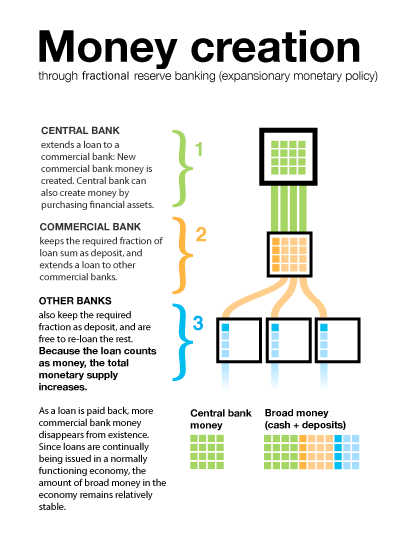
Most of the money in our economy is created by banks, in the form of bank deposits – the numbers that appear in your account. Banks create new money whenever they make loans. 97% of the money in the economy today is created by banks, whilst just 3% is created by the government.
One of the most often heard comments is how fiat currency can be printed on-demand. While most people think this statement is overrated, every governing body around the world can create additional fiat currency “out of thin air.” It goes without saying that, by increasing the total supply of fiat backed by the previous value, all money in circulation becomes less valuable.
Speaking of fiat currency being “backed” by assets to create the illusion of value, the US Dollar has not been tied to a tangible asset for quite some time. In fact, every US Dollar in circulation is backed only by “the full faith and credit of the United States”, and has no inherent or intrinsic value whatsoever.
How do banks create money in the economy?
The process whereby banks make loans equal to a number of their excess reserves and create new checkbook money is known as multiple deposit creation. Each time a bank receives a deposit, it sets aside some of it to meet reserve requirements and may lend an amount equal to the remaining excess reserves.
How is money created by the Fed?
Unlike your bank, the Fed can create new bank reserves as well as money. The primary way the Fed does so is by buying and selling U.S. Treasury securities on the open market. For example: When the Fed buys $10 million of Treasury bills on the open market, it credits the selling banks' reserve accounts for $10 million.
How do banks create money through the fractional reserve banking system?
Decision Time
The question(s) you must ask yourself...
Can Fiat currency surpass digital currency in production speed, transaction time, security, or true value?
What is the process of money creation?
The money creation process is a natural feature of fractional-reserve banking that occurs as banks act as both safe keepers of deposits and financial intermediaries making loans. Banks keep a portion of available reserves to back up deposits, then lend out excess reserves, creating checkable deposits in the process.
How do banks create money through the fractional reserve banking system?
Through Money Creation. Because banks are only required to keep a fraction of their deposits in reserve and may loan out the rest, banks are able to create money. To understand this, imagine that you deposit $100 at your bank. The bank is required to keep $10 as reserves but may lend out $90 to another individual or business.
Will cash become extinct?
Jason Oxman, CEO of the Electronics Transactions Association in a Washington, D.C. trade group that represents the electronic payments industry, says consumers are embracing electronic payments because cash isn’t a safe, secure, reliable or rewarding way to pay for products or services.
Earn Capital through the evolution of Currency and Payment Systems
FIDUCIARY FREEDOM FOREVER™
Bitcoin value is up over 200% from this time last year. How’s the dollar doing?
A $20 bill that’s lost or stolen might never be recovered, but a fraudulent credit card charge is no loss to the consumer because credit cards typically offer consumers zero liability for fraud charges. Cards are widely accepted — more than 8 million merchants accept them in the U.S. alone — and they allow consumers to buy now and pay later, Oxman says.
New technologies are aggressively targeting all transactions, including those that involve just a few dollars, a territory long controlled by cash even in the age of credit cards.
Examples of these technologies include smartphone apps such as Google Wallet and Starbucks, virtual currencies like Bitcoin, and person-to-person payment services like PayPal. Traditional banks, thrifts and credit unions also offer smartphone payment or money-transfer apps or other electronic payment systems.


